• Home
  • /Archive by category 'Physical Therapy'

Archive for ‘Physical Therapy’

Lakeside Expanding!

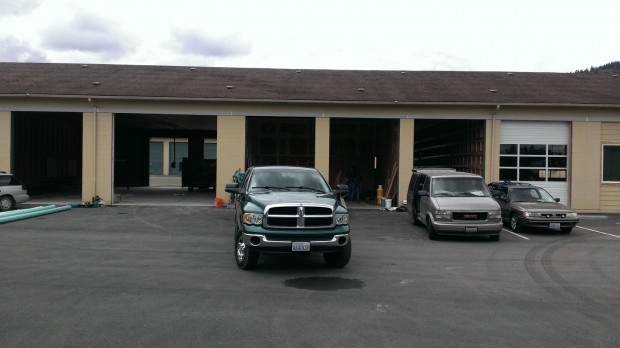
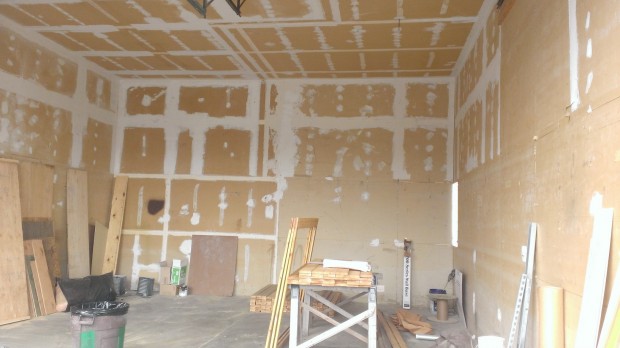
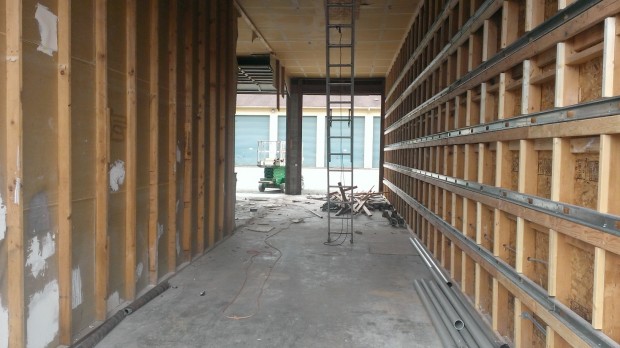
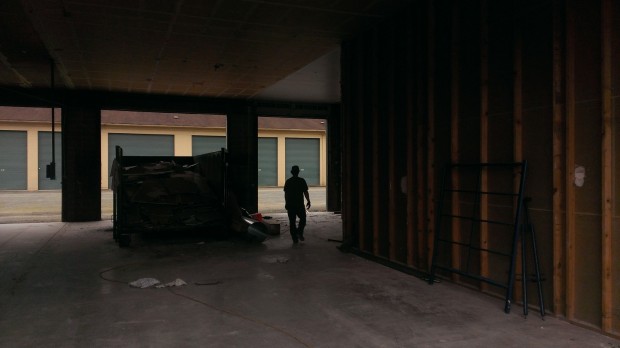
We are thrilled to let you all know that Lakeside is in the process of expanding its operations in the Issaquah area! We will be adding an additional 4500 square feet that will increase our capacity to provide our services to children and families affected by autism. Attached you will find pictures of the space that is being prepared for the opening in August of this year. In addition to the space that we are adding, Lakeside will be working on improving its internal systems with the integration of an electronic medical records system. Not only will this improve the communication and efficiency within our daily operations for our team, but it will create streamlined communication with the families of Lakeside. The system will include a patient portal to communicate with your child’s team and many more features we will be sharing in the near future. As we go through this process, we are working vigorously to ensure any transitions or changes happen as seamlessly as possible. We want to thank the families of Lakeside for the opportunity to provide care and support!

WP_20130531_005 WP_20130531_004 WP_20130531_003 WP_20130531_002 WP_20130531_001


Summer ACTIVE-ities – Part One!

All the spring weather we’ve been having the last two weeks has made me VERY anxious for summer to get here. (This California girl is choosing to ignore the fact that it was “snowing heavily” in North Bend only yesterday…and the fact that summer doesn’t come to this area until July 5th…)

sun

Pretty spring weather (and the promise of eventual summer) brings with it the opportunity to get outside and take advantage of the beautiful outdoor activities available to us in the Pacific Northwest.  One of my favorite activities for taking advantage of the precious sunshine is biking.

As a PT, I love biking for a lot of reasons.

Biking promotes:

– upright posture.

– bilateral coordination (two legs working together in that reciprocal pedaling motion).

– coordination of upper and lower extremities (pedaling AND steering).

– lower extremity strength (pedaling up those steep driveways and hills).

– cardiovascular fitness (getting hearts pumping and blood flowing).

The great thing about biking is that it develops the important things listed above, and it’s FUN!!! This means that it is inherently motivating! Kids know that biking is a blast and that is all that they need to know!  Biking with family and friends also provides a great opportunity for social interaction.

With this in mind, I’d like to invite you all to a biking event at Lakeside Center for Autism this Friday… Outdoors for All is coming!!

ofa_logo_v_cmyk

Outdoors for All is an organization that provides adaptive equipment and assistance to allow all people to access outdoor activities, and they are bringing an actual TRUCKLOAD of adaptive bicycles to the clinic.  Stop by the clinic from 5-7pm THIS FRIDAY MAY 3RD for some fun biking activities! Your LCA physical therapists will be on hand to answer any questions, and provide tips and strategies to maximize your child’s success on wheels!

Hope you can join us!!

Posted by: Amanda, Physical Therapist

Dyspraxia!

Dyspraxia. Have you heard of it? Can you guess what it means? Even if you think you have no idea what it is, you’ve undoubtedly seen it in kids and adults and didn’t know what to call it! Check out this brief overview from the National Center for Learning Disabilities that explains what dyspraxia is and how it affects individuals.

Have you noticed these characteristics in kids or adults that you know? Just as some kids have trouble with learning math or reading skills, kids with dyspraxia have trouble learning motor skills. Think about how often and in how many places kids need to move… everywhere! Playgrounds, home, school, sports teams, community places like museums, stores, parks! If kids are having trouble moving their bodies in all these places, can you imagine what that might feel like? If kids want to play a ball game with other kids, how long will they want to stick with it if they just can’t get their body to catch a ball? If they can’t climb up to reach a slide at the playground, would it simply look to someone else like they don’t want to play? All of those scenarios sound pretty frustrating to me!

This week, our preschool staff was able to get a small glimpse of what that feels like. Thankfully, they were up for the challenge to try to experience something that so many kids experience everyday. Each staff member had one of their eyes covered with an eye patch (to simulate difficulty with visual tracking and teaming of eyes together), their dominant hand tied behind their back (to simulate difficulty coordinating the Left and Right sides of the body, also called bilateral coordination), and their legs tied together (to simulate balance and body control difficulties). They were then given tasks to attempt to do that we ask kids to do on a daily basis. While it was silly to see the attempts, it was also an eye-opening experience to see how frustrating seemingly simple tasks can be with dyspraxia! All of a sudden, asking a kid to sit “criss-cross applesauce” doesn’t seem like such an easy request!

Sara tries to build a Lego structure to match the one that already was made:

Sara building Legos


Here’s Tina trying the balance beam and jumping with two feet:

Kavita attempts to put a shirt on:

kavita putting on a shirt

Jaimi learned how difficult it is to catch and throw a ball:


Posted by: Carrie, Physical Therapist

Motor Skill Tip: Flamingo Stand


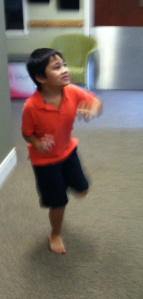
The blurry picture above shows how wiggly this kiddo was when trying our next motor skill idea: Flamingo Stand! Flamingos are the absolute best at standing on one leg, and what better animal to try to be when working on those balance skills? Practicing standing on one leg like a flamingo works on a lot of skills:

Leg strength
Core strength
Balance reactions
Imitation (especially if you have the kiddo try to match your body position)
Body awareness
Coordination of the Left and Right sides of the body
Motor planning

Getting a kiddo to try standing on one leg, especially when it is very challenging for them, can be tricky! Some ideas to try to sneak in this practice is trying to stand like a flamingo in line at the grocery store, while brushing teeth, or having contests with siblings or peers while playing games at home. You can challenge a kiddo to increase their balance time by giving them a time based-goal, such as 5 seconds or 7 seconds. If a child needs support, you can start by having them hold onto a counter or the wallt, then gradually move away from that support as they are able. If a kiddo bends at the hips to try to keep balance or is unable to stand on one leg for more than 1-2 seconds without support, it may still be beneficial for them to still try this skill while holding on (just slightly!) to a counter or wall so they can build their skills. Once they’ve (or you’ve!) mastered balancing on one leg without holding on to support, add the next step: hopping! Remember to try both legs…no lopsided flamingos!
Posted by: Carrie, Physical Therapist

Why We Love Being Physical Therapists!


Carrie –

“I love being a Physical Therapist (PT) for SO many reasons! Ultimately, exploring a child’s world with them is refreshing and challenges me to see things with an open mind. When I get the chance to take the time to explore with a child, I am reminded how important it is to take time to look at the world around instead of being caught up in my own busy world! The look on a child’s face when they achieve a new skill, such as climbing, bike riding, or jumping, that allows them to expand the ways in which they experience and explore their world is my favorite part of being a PT. The look on their face at that moment is one of freedom, fun, and exhilaration that can’t be matched anywhere else. Lastly, I love being a PT because I get to have fun at my job every single day!”

Amanda –

“I love being a PT because I get paid to play! :) Well, it’s not quite as simple as that, but in a way it’s true. I love the challenge of having objective, clinical, ‘grown-up’ goals to accomplish and finding ways for therapy sessions to be engaging, motivating and FUN for the kids I work with! Sometimes I have to be pretty sneaky to get kids to do things that are hard for them, but the payoff is always worth it. I love seeing the joy on the faces of the kids and their families when I share the little (and not so little) victories as my patients progress as a result of the work we do together.”

October Is Physical Therapy Month

Physical therapy promotes gross motor skill development and can help children improve their strength, coordination, balance, and motor planning. Physical therapy helps children to explore their environments, engage in peer interactions and expand their recreational play skills.

It’s a small department here at Lakeside, but our physical therapists (PTs) make a big difference!! Carrie and Amanda are excited to spend the next few weeks sharing all the great things about their profession with the Lakeside community.

Amanda and Carrie are also excited to announce Lakeside’s Motor Skill Olympics in celebration of all things PT! Olympians of all ages are invited to complete challenging “events” with their families and their other therapists at LCA. Participants can earn medals and have their hard work recognized on our “Wall of Fame.”

Be on the look-out for bulletin boards and blog posts with lots of great information, stories, and family testimonials.

Kinetix Academy Begins!

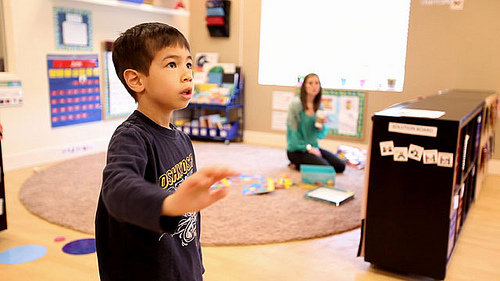
Child enjoying a Kinect game.

Whew! We are more than halfway through the 54 hour Seattle Start-Up Weekend marathon! When Dan & I signed up for this over a month ago I don’t think either of us had any idea what we were getting ourselves into! All we knew was we had this big idea and we needed help to really get it off the ground. When LCA won the “Innovation in Issaquah” award for our use of the Kinect in therapy the speaker mentioned the entrepreneurial spirit in Washington and put up a link to startupweekend.org. I checked it out that day and then kind of forgot about it for a while as Dan and I explored other avenues to try to launch this idea. I feel like we’ve been in this frustrating place where every time we talk about this idea with someone, be it other therapists, Microsoft employees, researchers, developers, or potential investors, we kept hearing “wow, that is a great idea!” but never got quite the traction we needed to really push this idea into anything other than that…a great idea. So, when we heard that there was a start-up weekend scheduled in Seattle we figured we might as well give it a shot.

So here I am, at almost midnight on a Saturday night, having worked on this pretty much straight through since about 9am and although I am physically exhausted I can’t seem to find the off switch for my brain! I don’t know if it is the caffeine (I haven’t had regular coffee in over 6 months and had 3 grande Americanos today!) or the sheer adrenaline of seeing our ideas actually become a reality, but I really need to find that off switch so I can sleep and be ready to rock and roll again bright and early tomorrow morning!

What is our great idea you might ask? Well, it is to create a comprehensive curriculum of educational and therapeutic games specifically designed for children with autism to support their development of motor, speech and language, cognitive, academic, and social skills….and it’s called Kinetix Academy. Ever since I caught wind of the Kinect (back when it was still called Project Natal) I’ve been dreaming about how we could use this technology to support kid’s gross motor skills. Over the past six months or so I’ve slowly put some of those ideas down on paper and started to think through the developmental sequences, feedback and reinforcement schedules, and opportunities to target other areas of development. I think I kind of off-handedly mentioned this idea to Dan one day and he took that idea and ran with it and started outlining a curriculum targeting all sorts of different areas of development and thinking about how we could harness the ever-improving speech recognition technology to help kids with their speech and language goals. So my big idea suddenly got much bigger!

And the first thing we had to do to prepare for start-up weekend was to distill that BIG idea into a 60 second pitch to convince people that our idea is worth making a reality. That was quite the task and Dan and I finally whittled it down and practiced our pitch about a zillion times Friday afternoon on any poor LCA staff member or family member we could catch! All that practice paid off and although we were both super nervous I think our pitch went really well and generated a little bit of buzz. Trouble was there were about 40 other people pitching ideas and some of them were pretty cool ideas. Once everyone had a chance to pitch there ideas it was time for the voting and frantic team building/recruiting to begin. Now mind you, Dan & I are both complete rookies at this and had no idea what to expect. We thought once people voted that the top ideas would be announced and people would choose one of those 5 or so teams. In actuality it was complete chaos with over 100 people jammed into a small-ish space trying to expand their 60 second pitches, recruit key team members, and generally not get lost in the shuffle.

For a little while I thought, “oh no, here we go again” as I had one person after another say “Oh, wow, your pitch was so great! That is such an awesome idea” or “I totally voted for you, love your idea!” as they then went on to recruit for their own idea or followed with “but I don’t really have any skills that can help you.” But we got Shashi and he helped champion our idea and pointed us to Justin who had experience developing for Kinect. It was just the four of us and we knew we desperately needed a designer to help with the graphics, but as people settled into their teams and started staking out table space it became clear that designers were in short supply so we decided to give it a go with our mini-team. And ya know what, our mini team is doing just fine! We’ve had a few mentors and others stop by to pitch in here and there but mostly it’s just been the four of us. It’s Saturday night and we have a functioning Kinect application with some cute kid-friendly graphics that hopefully shows that this idea is possible; that we can target gross motor skills, following directions, and color concepts all in one simple little game.

We still have a lot of work ahead of us before the final presentations begin at 6pm tomorrow! But I actually think we’ll be okay. Tomorrow morning at 8am we’re meeting the amazing Miller family for some user testing and validation and making any final changes to the game. Then it’s full throttle on perfecting our final pitch. This time we get five whole minutes…which of course seems like nothing when we have so much great information to share about Kinetix Academy! If you read this before 6pm tomorrow, follow all the action on our twitter feed @KinetixAcademy or on our Facebook page www.facebook.com/kinetixacademy and when it’s all said and done we’ll try to post our final pitch video here so you can decide for yourself if this idea is worth investing in! Now it’s time for bed…wish me luck finding that off switch!

Posted by: Mari, Physical Therapist

Tummy Time – Not Just for Babies!

“Tummy time” is a phrase many parents, teachers, and therapists are familiar with. However, it’s typically only associated with babies. It’s definitely important for babies to spend time on their stomachs everyday, but “tummy time” is not just for babies! Toddlers, older kiddos, and even adults can benefit from (and even enjoy!) spending time on their tummies. But besides saying a very close “hello” to the ground, what’s it for?

“Tummy time” is important because it:

  • Increases neck strength and head control
  • Increases back and arm strength
  • Works on using upper body muscles in a coordinated manner
  • Increases strength and endurance of core muscles

And why are those things important? They help with:

  • Upright head and body position to participate in communication
  • Strong arms and core muscles for handwriting, climbing, throwing and catching balls
  • Endurance of postural muscles for sitting upright in class for increased focus and participation
  • Coordination for climbing, riding a bike, swinging a bat, playing sports

And although “planking” is pretty popular lately (http://en.wikipedia.org/wiki/Planking_(fad) ), “tummy time” doesn’t always need to look like laying flat on the ground. There are so many ways to spend time on your “tummy” and improve those areas listed above. Check out some pretty adorable kiddos showing off different ways to spend time on their tummies!

Laying over legs, this little guy is working hard to hold one arm up while turning the page of a book with his other arm.

Another kiddo working on the same skill – holding one arm up while playing with the other arm. He’s laying over a foam block to do the same thing. A pillow also works great!

She is swinging on her belly in a hammock swing, giving “high fives” and pushing off each time she swings up!

These two are sharing stories while laying over a stuffed pillow and a therapy ball.

Posted by: Carrie, Physical Therapist

Physical Therapy and Autism Spectrum Disorders

I’ve been planning to write this post for months now and it just keeps getting put on the back burner.  But this week this article was posted online –  http://www.sciencedaily.com/releases/2011/09/110906212012.htm  – and I decided now was the time! This study looked at infants who have older siblings diagnosed with Autism Spectrum Disorder (ASD) and found that these infants had poorer movement than children in the general population.  The body of research about motor skills in children who are diagnosed with ASD has also been growing.

Although it is not included in the diagnostic criteria, children with all sub-types of ASD often display signs of motor impairment with studies estimating that 50 to 80 percent of children with ASD have some type of motor difficulties.  One study found such high rates of motor impairments in children with ASD that the researchers suggested that assessment of motor skills should be considered part of the routine assessment for children diagnosed with ASD.  Other researchers have even hypothesized that motor impairments may be a core deficit in individuals with ASD.  Yet, despite this growing evidence of motor difficulties, physical therapy is not yet considered a core treatment for most children with ASD, and in fact there are no intervention studies in the literature yet.

When I interviewed at Lakeside in April of 2009, Dan and I talked about how much physical therapy time LCA would need and we thought one, maybe two, days a week would be plenty.  But within about six months of working here I began to see more and more kiddos in speech or OT that I thought would benefit from PT services and my waitlist began to grow.  This trend has continued and this summer we hired another physical therapist, Carrie, to help us meet the needs of the families we serve.

It has been an amazing and rewarding experience to help so many kiddos learn to move their bodies in new ways.  The best part for me has been seeing how getting kids moving can spark other areas of development including affective engagement, speech and language, and fine motor. This makes sense because gross motor skills are the first to develop in infants and children.  Children learn a great deal through moving their bodies and exploring their environment.   As was mentioned in the article I linked to above, there is a fair amount of research that suggests that poor motor development can negatively impact language, social, and cognitive development.  So much of childhood play is motor based (running, jumping, climbing, playing catch, bike riding, etc) that if children with ASD don’t feel confident moving their bodies it can result in increased social isolation, which is the last thing our kids need.  That is why Carrie and I are so excited to be part of the amazing team here at Lakeside helping kiddos get their bodies movin’ and groovin’!

Posted by: Mari, Physical Therapist